By SKM
November 4, 2025
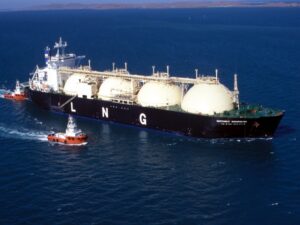
ISLAMABAD: In a rare display of strategic agility, Pakistan LNG Limited (PLL) has inked a deal with Italy’s ENI — one of its long-term LNG suppliers — to divert 32 liquefied natural gas (LNG) cargoes to the international market between 2025 and 2027.
The move, officials of the Petroleum Division say, will not only help defuse dangerously high pressure in the national gas transmission system but also generate around $880-900 million in savings and profits over three years. “So far in 2025, 11 ENI LNG cargoes have been diverted, saving Pakistan $300 million in import costs and generating $45 million in profits.”
Under the deal with ENI, the next 11 cargoes in 2026 are projected to save $230 million in imports, with an additional $45–50 million in diversion profits, bringing the total benefit to around $245–250 million. In 2027, 10 cargoes could yield $290–300 million, resulting in a cumulative gain of approximately $880–900 million over the three years.
As of November 4, gas “line pack” — the pressure inside the country’s transmission pipelines — has climbed to 5.21 billion cubic feet (bcf), breaching the 5 bcf danger mark. Fearing a potential rupture that could paralyze industrial operations and household supplies, authorities have opted to offload surplus LNG instead of feeding it into the system.
“It’s a win-win — we’re stabilizing the network and monetizing our excess supply,” a senior Petroleum Division official told this scribe. “Authorities are still in discussions with QatarEnergy to divert 24 LNG cargoes to the international market under the Net Proceed Differential (NPD) clause. Under this arrangement, if a Qatar cargo is sold above the contract price, all profits go to Qatar, while any losses—potentially up to $10 million per cargo, including operational costs—must be absorbed by Pakistan.”
In contrast, the PLL-ENI agreement has a more balanced structure. The management negotiated terms under which both profits and losses from diverted cargoes are shared, reflecting PLL’s commercial acumen and contractual flexibility.
This reflects PLL’s commercial acumen and its ability to negotiate effectively within the contractual framework. While the LNG procurement contract did not grant PLL the unilateral right to divert cargoes outside Pakistan, PLL leveraged the existing provisions that allow for such diversions based on mutual agreement between the parties. Through constructive engagement and negotiation, PLL secured the seller’s consent for these diversions, thereby creating commercial value and flexibility in a manner consistent with the contract’s intent.
The relevant contractual clause only permits diversions outside Pakistan “subject to mutual agreement of the Parties,” implying that such diversions require consensus on both operational feasibility and commercial terms. PLL successfully navigated this provision by reaching mutually beneficial terms with the seller, ensuring that the diversions were executed without compromising contractual obligations. The successful execution of these diversions not only underscores PLL’s operational competence but also highlights its strategic foresight in responding to market conditions.
For a country once desperate to import fuel for power plants, Pakistan’s new role as an LNG seller marks a stunning reversal. Demand for imported gas has plunged as regasified LNG (RLNG) becomes too expensive for industries and power producers alike.
AS of the latest data, Power plants are currently drawing only 165 million cubic feet (MMcf) of imported gas daily — a fraction of contracted volumes under long-term take-or-pay deals with QatarEnergy and ENI. Industrial consumption has also plummeted from 400 MMcf to barely 60–70 MMcf per day after RLNG prices surged beyond Rs4,200 per MMBtu ($15.36/MMBtu) following recent tariff hikes and levies.
PLL’s deal with ENI stems from a creative reading of the fine print. Although Pakistan’s 15-year LNG contract — priced at 12.14% of Brent — does not grant unilateral diversion rights, it allows diversions “subject to mutual agreement.” PLL’s negotiators used this clause to convert contractual rigidity into commercial opportunity.
To further manage the pressure, authorities have curtailed local gas production by 310 MMcf per day, angering exploration and production (E&P) companies that warn of reservoir damage and permanent output losses. Attock Refinery Limited (ARL) has also raised alarms, saying reduced gas flow is lowering crude oil output and disrupting refinery operations.
Meanwhile, the Power Division maintains that it must operate under the economic merit order (EMO) — giving priority to cheaper, locally fueled plants over expensive RLNG units.
“We can’t afford to raise electricity prices just to burn imported gas,” said a senior official.
Pakistan’s energy paradox — too little demand and too much imported supply — has now forced innovation. Negotiations are already underway with QatarEnergy to divert another 24 cargoes in 2026, as about three LNG shipments a month remain surplus.
Energy experts see this as an uncharacteristic stroke of foresight from a sector long accused of reacting to crises rather than anticipating them.
“Pakistan is finally using market flexibility to its advantage,” said one analyst. “It’s turning an oversupply crisis into a commercial opportunity.”
Whether this balancing act holds will depend on one thing: keeping the gas pressure — both literal and political — under control. Ends