
By SKM
September 4, 2025
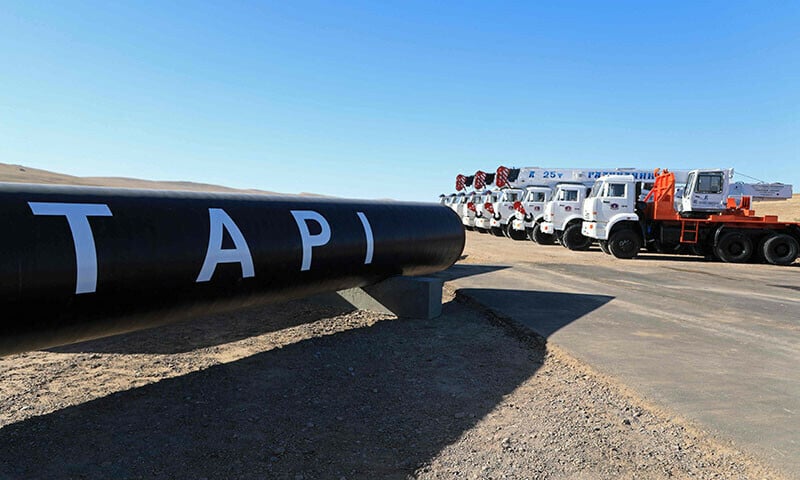
ISLAMABAD: Global energy consultancy Wood Mackenzie has advised Pakistan to delay committing to gas offtake from Turkmenistan under the TAPI pipeline until at least 2031, citing a major decline in domestic gas demand and a growing surplus of imported LNG.
The recommendation has triggered policy-level deliberations in Islamabad, where senior officials are weighing whether to formally inform Turkmenistan of a shift in Pakistan’s position on the $13 billion Turkmenistan-Afghanistan-Pakistan-India (TAPI) pipeline project.
Pakistan’s current energy landscape is marked by an oversupply of LNG due to sharply reduced gas consumption. The government is already engaged in talks with Qatar to defer 177 LNG cargoes worth $5.6 billion scheduled over the next five years, as these deliveries have become excess to requirements.
The surplus is the result of lower-than-expected gas demand from both the power and industrial sectors. RLNG-based power plants in Punjab are consuming just 250–500 mmcfd, well below their contracted requirement of 800 mmcfd. Meanwhile, industrial gas consumption has plunged from 350 mmcfd to around 100 mmcfd, driven by soaring prices—now at PKR 3,500 per MMBTU, plus a 10% off-grid levy.
This has turned Pakistan’s main LNG transmission pipeline into an over-pressured storage facility, with line-pack pressure exceeding 5 billion cubic feet—a critical threshold that poses serious infrastructure risks.
Without India, TAPI Becomes a Costly Burden
Amid this domestic oversupply, Pakistan is also reconsidering its participation in TAPI if India does not recommit to the project. According to senior officials, without New Delhi’s involvement, the pipeline becomes financially unviable for Islamabad.
“India’s position has been lukewarm. If it stays out, we lose $700–800 million annually in transit fees, and instead pay $500 million to Afghanistan just to bring the gas in,” said a top official at the Petroleum Division. “Add a $7.5 per MMBTU gas price, and the economics simply don’t work.”
In such a scenario, TAPI effectively turns into TAP—Turkmenistan-Afghanistan-Pakistan—a model Pakistan says it cannot afford. Without India as the end-market, Pakistan alone would bear the financial and operational burden of the project, while paying more than it does for RLNG, which it already has in surplus.
By contrast, if India stays in, Pakistan not only avoids paying transit fees but also earns revenue from India for allowing pipeline access. This could help offset the high cost of imported gas and make Turkmen supply more competitive.
TAPI: Big Ambitions, Bigger Hurdles
The TAPI pipeline is designed to transport up to 3.2 billion cubic feet per day (bcfd) of gas from Turkmenistan’s Galkynysh gas field through Afghanistan and Pakistan to India. Pakistan and India are each slated to receive 1.35 bcfd, while 500 mmcfd would go to Afghanistan.
Stretching 1,849 kilometers, the pipeline would enter Pakistan at Chaman, travel through Zhob, D.G. Khan, and Multan, and cross into India at Fazilika. Turkmenistan holds an 85% stake, while Afghanistan, Pakistan, and India hold 5% each, amounting to around $200 million per country.
But despite repeated pushbacks and a revised deadline of October 2023, financial closure for TAPI has yet to be achieved. Persistent concerns around security in Afghanistan, weak regional commitments, and limited investor appetite have delayed full-scale construction.
Adding to the complexity, Turkmenistan has requested legislative protection under Pakistan’s Foreign Investment Promotion and Protection Act (FIPPA), 2022 for its investment in Pakistani territory. However, Pakistan has declined, citing that neither Afghanistan nor India has granted such cover. Instead, Pakistan has offered a sovereign guarantee under the Host Government Agreement (HGA) to protect Turkmen interests.
India’s Silence: The Deciding Factor
While India hasn’t formally withdrawn from TAPI, its cautious and non-committal stance has raised alarm in Islamabad. Citing security challenges in Afghanistan and its shifting energy priorities, India has shown little urgency in pushing the project forward. Officials in Pakistan fear a repeat of the Iran-Pakistan-India (IPI) pipeline, from which India exited in exchange for favorable energy agreements with the U.S.
India’s continued hesitation is now a make-or-break factor for Pakistan’s participation. Without clear commitment from New Delhi, officials say the project no longer makes commercial or strategic sense for Islamabad. Ends