
By SKM
May25, 2025
ISLAMABAD: India, under its the master plan to block the mighty Indus River’s flow begins in Ladakh, a disputed territory under UN resolution, has unveiled plans for 10 new mega hydropower projects in Ladakh, including Achinthang-Sanjak, Parfila, Sunit (Batalik), and Khalsti. These projects not only violate the storage capacities allowed under the treaty but also raise grave concerns about the diversion and reduction of water flow into Pakistan.
The purpose of these projects, it seems, is to provide heating and energy facilities for troops stationed on the frozen expanse of the Siachen Glacier—while the poor, marginalized people of Ladakh are left in the cold, this has been unearthed in a letter from Arshad H Abbasi, an eminent water expert of Pakistan with headline of ‘A Humanitarian Crisis in the Making: The Indus Waters Treaty and India’s Actions’ to Mr. António Guterres
Secretary-General, United Nations.
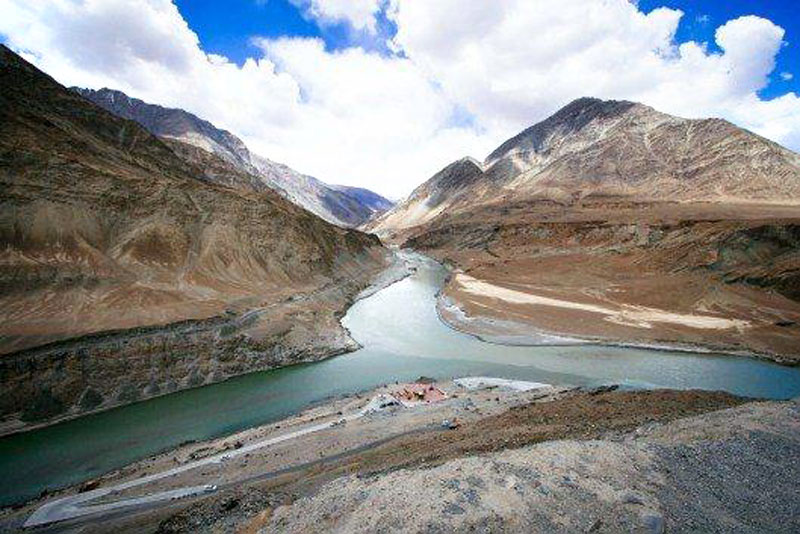
Tragically, and in a deeply alarming turn of events, India suspended the Indus Waters Treaty (IWT) on April 24, 2025, a reckless decision that has escalated tensions over water rights to a breaking point. The treaty, a landmark agreement brokered by the World Bank in 1960, has for decades been a cornerstone of peace and water-sharing between India and Pakistan, governing the usage of the Indus and its tributaries. Yet, the geography of the Indus poses a daunting challenge—it flows for roughly 500 kilometers through Ladakh, which is under Indian control.
Mr Abbasi says it his letter: “Under the provisions of the IWT, India is permitted to store up to 0.25 million acre-feet (MAF) of water for general and power storage in Ladakh. But in a shocking disregard for these limits, India has developed plans that far exceed these allowances. Over the years, India has constructed hydropower projects in Ladakh, including Nimoo Bazgo and Chutak, with capacities of 45 MW and 44 MW, respectively, to serve not the people of Ladakh but the Indian Army’s XIV Corps. Established in 1999, this massive military deployment operates in the Kargil-Leh area, supported by residential colonies, military airports such as the Kushok Bakula Rimpochee Airport, and the Thoise Airbase near the colossal Siachen Glacier.”
This harrowing reality came to light on May 21, 2025, when Indian Prime Minister Narendra Modi delivered a grim and foreboding warning to Pakistan regarding the Indus Waters Treaty. Standing before a crowd in Rajasthan’s Bikaner, Prime Minister Modi declared with chilling finality that Pakistan would not receive even a single drop of water from the rivers originating in India, including the life-giving Indus River, which India brazenly claims as its rightful share.
Mr Abbasi drew the attention of Mr. Secretary General saying that this cruel and heartless act by India is nothing short of a death sentence for Pakistan. But it is not merely that—it signifies the end of an era, the demise of the Indus Valley Civilization, one of the most ancient and enduring civilizations in all of human history. The sacred Indus River, immortalized by the Greeks in 325 BC under Alexander the Great and revered by ancient Iranians as “Sindhu,” meaning “river” in Sanskrit, has been a lifeline for countless generations.
“One of the most disturbing reasons for India’s blind rush toward massive water-storage hydropower projects is the negligence and silence of the Pakistan representative at the UNFCCC,” he mentioned.
He requested for investigation into how the UNFCCC, a crucial organ of the UN, awarded carbon credits to India for the controversial Nimoo Bazgo and Chutak hydropower projects. “Both projects are located on the Indus River in Ladakh, and both were undertaken without prior consultation with Pakistan or the required transboundary assessment.”
Even more alarming, he said, is India’s construction of a 45-kilometer inland water transport route on the Indus in Ladakh, stretching from Upshi village to Shey village (NW-46). This initiative involves constructing barrages to manipulate water levels, with one weir already completed at Ugu village. While these projects are portrayed as efforts to enhance transportation and energy, their strategic and sinister implications cannot be ignored.
“The question is not whether Ladakh needs such projects but why they are being pursued at all. Ladakh is sparsely populated, with a population that suffers from severe energy losses during transmission. In winter, the Indus often freezes, rendering these hydropower projects ineffective. Yet, Ladakh has over 300 sunny days each year and enormous potential for solar energy. Leh, Ladakh’s capital, enjoys an average daily solar output of 5.29 kWh/kWp—far exceeding Delhi’s 4.0 kWh/kWp. But instead of harnessing this renewable wealth, India has chosen hydropower and water transport projects for reasons that serve an agenda of domination, not development.”
“This grim agenda was confirmed in Indian Prime Minister Narendra Modi’s speech on May 12, 2025, when he declared that “water and blood cannot flow together.” This chilling statement was accompanied by a vow to reduce the Indus River’s flow into Pakistan to zero. If fully realized, these projects could decrease the Indus’s flow by over 23 MAF, a catastrophic blow to Pakistan’s agriculture, economy, and water security. This would not be merely a crisis—it would be the destruction of an entire nation.”
In the depths of Sindh, a land parched by desperation, the people mourn the very lifeblood that once flowed abundantly through the Indus River. For centuries, the river’s waters have been entwined with their sacred traditions, a divine essence that coursed through their veins like lifeblood. Now, as the river’s flow falters, their protests echo through the desolate landscape, a desperate cry to preserve the sanctity of their beloved Indus. For six long months, their voices have risen, a poignant testament to their unwavering devotion, and the world watches in sorrow, aware that the loss of this river’s waters would be a death knell for the soul of Sindh.
In Sindh Province, the Indus River is not just water—it is life, history, and identity. Today, 60 million hearts in Sindh, particularly, are breaking with despair, anger, and unrest. Millions downstream of the Kotri Barrage, including Karachi’s 20 million residents, depend solely on the Indus for survival. Without it, their existence is unthinkable.
Mr Abbasi called upon the United Nations to take swift action to reinstate the Indus Water Treaty. Ends